
Plugging numbers in without a diagram
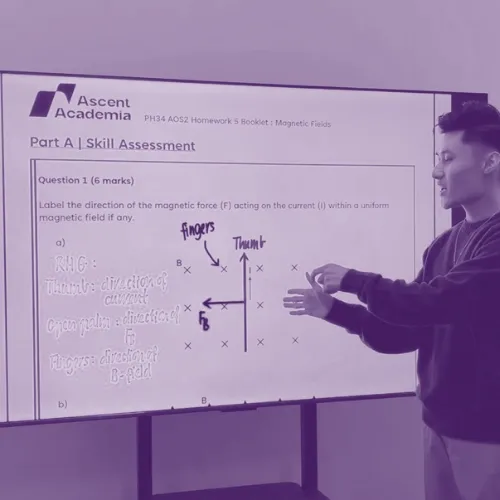
Most errors in mechanics and fields start with a missing force or the wrong direction. We make a labelled diagram the first line of every solution.
Physics 3/4 · Vermont
Vermont families are about 15–20 minutes from our Box Hill centre by car. Physics is one of the subjects many big centres don’t teach in small groups. We do — with booklets, practice SACs and marked trial exams.
First week free, per subject. No payment details needed.
How we teach it
VCE Physics asks students to do three things at once: understand a physical idea, translate it into the right equation, and explain it in words an assessor will give marks for. Most students are stronger at one of these than the others. Our classes train all three every week.
Each two-hour lesson class of up to eight students follows our own Physics booklet in study-design order. The tutor builds the concept with diagrams and demonstrations, works examples, then sets exam-style questions — including the written-explanation questions that cost students the most marks. Every booklet section ends with VCAA-style practice so students see how each idea is tested.
Classes run at our Box Hill centre, about 15–20 minutes from Vermont. Students from Vermont Secondary College, Emmaus College and other local schools all follow the same VCAA study design, so our booklets line up with what's taught at school.
Term-by-term plan
Newton’s laws · Projectile motion · Circular motion · Springs · Momentum and impulse · Energy conservation
Introduction to fields · Gravitational fields · Electric and magnetic fields · DC motors
Electromagnetic induction · AC/DC generators · Transformers and power transmission
Wave model of light · Young’s double-slit experiment · Photoelectric effect · Matter waves and wave–particle duality · Special relativity
Whole-course revision · Full trial exams · Marked papers with feedback
Section A
Most errors in mechanics and fields start with a missing force or the wrong direction. We make a labelled diagram the first line of every solution.
"Explain" questions are marked on specific physics points. We teach a structure that hits each point in two or three sentences.
Uncertainty, graph analysis and experimental design appear in SACs and the exam. We practise them throughout the year, not just in Term 3.
Motion and fields exam-style questions with worked solutions.
Your tutors
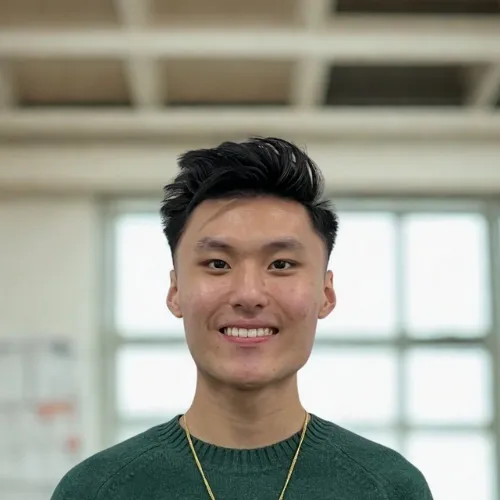
Co-founder · Head of Physics & Chemistry
Physics 3/4 · Chemistry 3/4
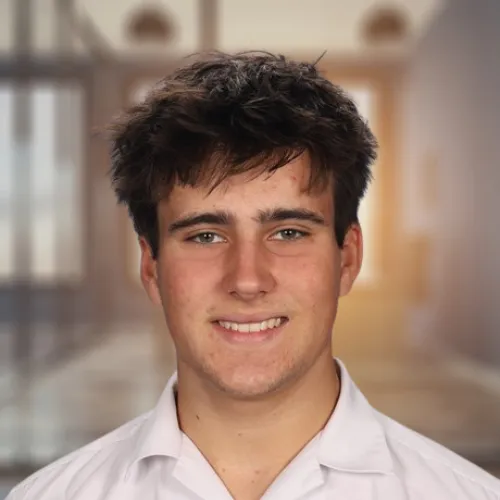
Methods & Physics tutor
Raw 50 Methods · Raw 46 Physics · 99.85 ATAR
Methods 1/2 · Methods 3/4 · Physics 3/4
Proven results
50% on first SAC → “huge improvements”
“Had Ivan tutored me for physics after I received 50% on my first SAC. Not only he was helpful and organised, he makes the subject so much more interesting to learn. And I have seen huge improvements in my results.”
Passed every SAC and subject in Year 12
“Ivan is an amazing tutor always helpful with a lot of resources and very knowledgeable on the topic. … Available whenever I needed help no matter what time. Throughout my year 12 studies he helped me improve and learn from my mistakes leading me to pass all my sacs and the subjects.”
“I highly recommend Ivan for VCE Physics tuition! Ivan has a unique ability to break down difficult concepts into simpler, easy-to-understand explanations. … I was also provided with many resources and exam style questions from the very start of the year which was incredibly helpful as it made my final VCE Physics exam preparation less stressful.”
FAQ
At our centre at HL1.28/847 Whitehorse Road, Box Hill VIC 3128. It's about 15–20 minutes from Vermont by car.
$80 a week for a 2-hour lesson class plus a 2-hour application class — 4 hours of class, about $20 an hour — including booklets, homework, help desks and messaging support. Your first week is free.
Up to 8. That's small enough for the tutor to check every student's working in every lesson.
In person at our centre on Whitehorse Road, Box Hill.
We teach the skills it assesses — experimental design, uncertainty and data analysis — and give feedback on structure. The investigation itself must be the student’s own work.